If your agent workflow only lives in chat, you do not have a workflow
A practical test for whether an agent workflow is portable: can the project carry the capability, can another operator discover it, and can a handoff survive without private prompt memory?
If your agent workflow only lives in chat, you do not have a workflow
Before adopting another AI coding tool, run a smaller test.
Name one workflow you repeat often enough to notice when it breaks. Release notes. Code review. Research induction. Incident response. Upgrade planning. Customer discovery. Publication QA.
Now answer one question: where does that workflow live?
If the answer is “in the chat where it worked last time,” you have something useful—but it is not yet a durable workflow. You have a transcript, a habit, and perhaps a prompt you hope will behave the same way next week.
That is fine for an experiment. It is a fragile foundation for a team.
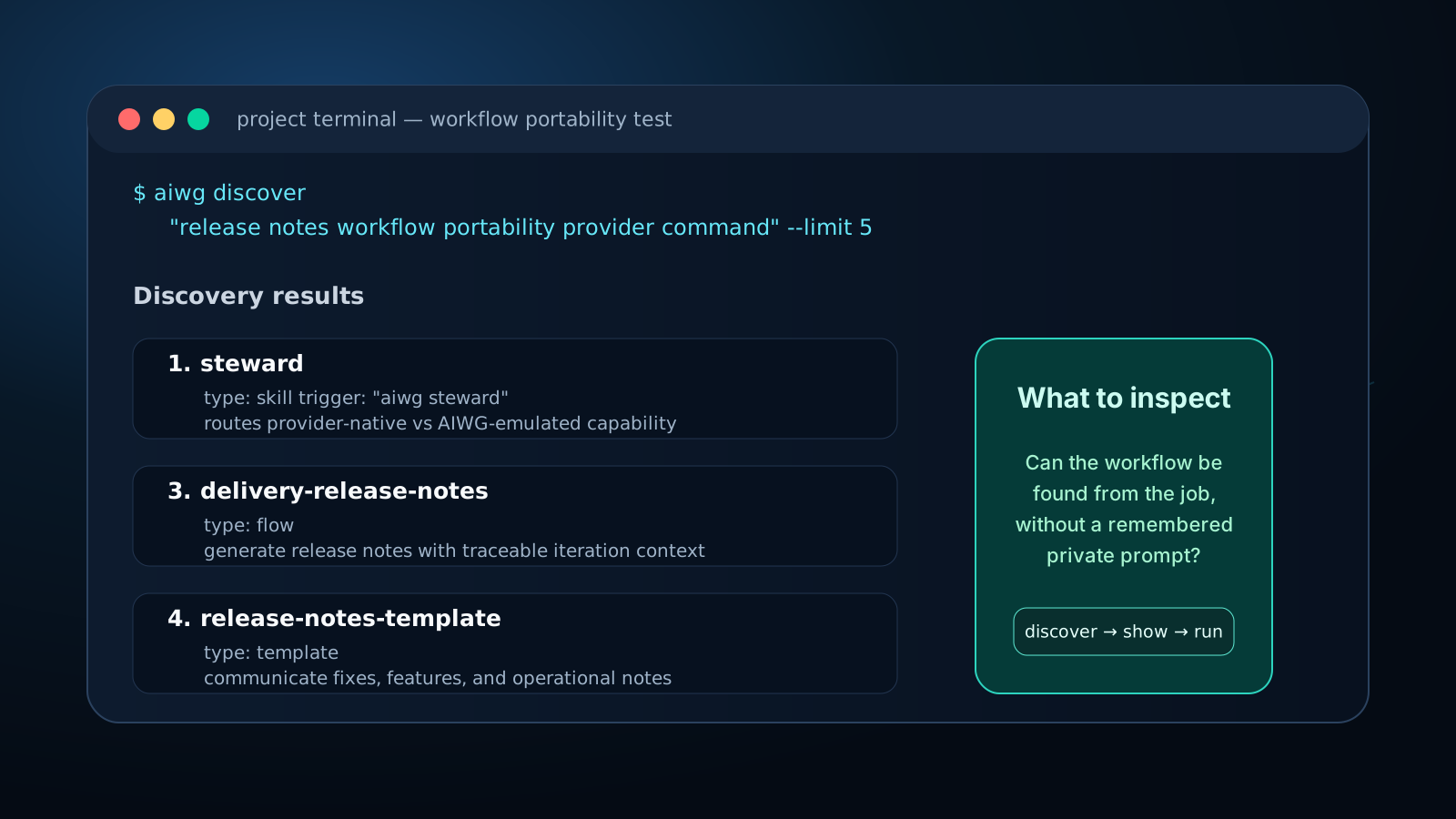
Representative discovery flow: a workflow becomes portable when it is named, discoverable, and carried by the project rather than trapped in one chat transcript.
Take the portability test before reading further
Choose one real workflow and score one point for every “yes.”
1. Can a teammate discover it without asking you for the magic phrase? 2. Can it run in another repository without copying an old conversation? 3. Can it move to another AI provider without a ground-up rewrite? 4. Can someone inspect its rules, templates, gates, and assumptions before trusting the output? 5. Can the team improve the workflow once and share that improvement?
A score of zero or one does not mean the workflow is bad. It means the useful knowledge is still attached to a person or session.
That distinction matters. Teams often blame agent inconsistency on the model when the real failure is packaging.
The hidden process is doing more work than the prompt
Consider a release-note workflow. The visible instruction might be short: “Draft release notes for this version.” The real process is not.
The agent may need to know which commits count, how to classify breaking changes, which issue references are public, what tone the project uses, which claims require verification, how maintainers format links, and who approves the final draft.
If those decisions exist only in one operator’s memory and a previous chat, the next run begins by reconstructing the organization.
This is how prompt sprawl starts. Someone saves the successful prompt. Another person adds an exception. A third pastes in a style guide. Soon the “prompt” is a compressed operating manual with no clear ownership, version, or test.
The team did not create a reusable capability. It created folklore with syntax.
A portable workflow has a durable center
Portability does not mean every AI provider behaves identically. They do not. Each exposes different primitives: rules, skills, commands, agents, plugins, context files, or tool integrations.
The goal is a stable center with provider-specific delivery at the edge.
That center needs:
- a name people can use;
- metadata that lets the system find it from intent;
- source-controlled instructions a reviewer can inspect;
- templates and gates where consistency matters;
- explicit inputs, outputs, and stopping conditions;
- a deployment path for each supported provider;
- a failure mode that produces a useful diagnosis.
Once those pieces exist, a provider switch becomes an adapter problem rather than an organizational-memory crisis.
The project should carry the capability
AIWG treats agentic capability as project material: skills, agents, rules, flows, templates, and bundles that can be discovered, inspected, deployed, and revised.
The AI platform still executes the work. AIWG is not a model runtime. Its role is to give reusable work a durable home and place the right artifacts where the current provider can use them.
That separation is important. Chat is a productive working surface. It is a poor system of record.
Your repository already carries code, decisions, tests, schemas, and documentation because those things must survive people and tools. Recurring agent workflows deserve the same treatment.
Handoff is the honest test
Give a teammate a repository and one sentence: “Use our release-note workflow.”
Watch what happens.
If they need your private transcript, your exact prompt, and a ten-minute explanation of exceptions, the workflow remains person-bound.
If they can describe the job in ordinary language, discover the capability, inspect its source, run it, and understand why it stopped, the workflow has become an organizational asset.
The same test applies to provider changes. The new tool may expose different native features, but the team should not lose the workflow’s purpose, evidence, or quality gates.
Discovery is part of portability
A workflow no one can find is only theoretically reusable.
The interface should be intent, not memorization. In AIWG, an agent can search the installed capability surface with a request such as:
aiwg discover "write release notes"It can then inspect the selected source before acting:
aiwg show skill <name>This creates a debuggable route. If the correct workflow exists but does not rank, the team has a metadata or indexing problem it can fix. “The model forgot our prompt” is replaced by a concrete failure report.
Start with one workflow, not a migration program
Do not package everything at once. Pick the workflow with the clearest repetition and the highest cost of inconsistency.
Write down:
1. what the workflow is called; 2. the event that starts it; 3. the context it requires; 4. the artifact or decision it must produce; 5. the proof gate that makes the output trustworthy; 6. the point where it should stop and ask a human; 7. the natural-language phrases a teammate would use to find it.
Then place that capability with the project and run it from two environments.
You do not need a promise that every agent will behave identically. You need evidence that the work can be found, inspected, repeated, and improved without recovering last Tuesday’s chat.
That is the portability test.
Run it on one workflow. If the workflow fails, you have found a precise piece of infrastructure to build. If it passes, you have something much more valuable than a clever prompt: a capability the team can keep.
Next action: inspect the AIWG repository, or run the portability test first and stop if your current workflow already passes.
Tools & transparency
This article was drafted with AI assistance, then edited for voice, claims, and publication fit. Product behavior should be verified against the AIWG repository and docs on the day this post is promoted. The hero image is AI-generated. The supporting CLI visual is an illustrative reconstruction of the workflow shape, not a captured proof of one exact terminal session.